I’ve seen too many riders limp away from crashes that should have been minor because they wore the wrong boots.
You’re here because you know your feet and ankles need real protection. But walking into a gear shop or scrolling through options online can feel overwhelming when every boot claims to be the best.
Here’s the truth: most riders pick boots based on looks or price. Then they find out the hard way that their choice didn’t hold up when it mattered.
I’ve spent years studying what separates boots that protect from boots that just look protective. I’ve reviewed crash reports and talked to riders who walked away from accidents (and some who didn’t).
This guide shows you how to choose motorcycle boots fmbmotogear that will actually keep you safe. Not just comfortable or stylish. Safe.
We’ve tested materials under real conditions. We know which construction methods hold up and which ones fail. That’s what you’re getting here.
You’ll learn how to evaluate protection features, understand what materials matter, get the right fit, and yes, find something that looks good too.
By the time you finish reading, you’ll know exactly what to look for. No guessing. No hoping your boots will work if you go down.
The Core Purpose of Motorcycle Boots: Beyond the Basics
Look, I need to be straight with you.
Those sneakers you wore on your last ride? They’re not protecting anything.
I see riders all the time treating boots like they’re just another style choice. Something to match their jacket or look cool at a coffee stop.
That drives me crazy.
Here’s what most people don’t get. Motorcycle boots are tools. They’re built for one job: keeping your feet and ankles intact when everything goes wrong.
It’s Not About Walking
Your regular boots feel more comfortable. I know. They’re easier to walk in when you get off the bike.
But comfort at the gas station isn’t the point.
When you’re sliding across pavement at 40 mph, those fashion boots turn into sandpaper. Your ankle twists in ways it was never meant to move. And the impact when you hit the ground? That’s where bones break.
Certified motorcycle boots handle three things that matter.
Impact absorption. When your foot hits the bike or the ground, the boot takes that hit instead of your bones.
Abrasion resistance. Sliding on asphalt will shred regular leather in seconds. Proper boots use materials that can take that punishment.
Torsional rigidity. This is the big one most riders ignore. Your ankle wants to twist during a crash. A good boot won’t let it.
According to the Motorcycle Safety Foundation, foot and ankle injuries make up nearly 30% of all motorcycle crash injuries. Broken ankles, crushed feet, torn ligaments. All preventable with the right gear.
When you’re learning how to choose motorcycle boots fmbmotogear can help, the first question isn’t about style.
It’s about whether that boot will keep you walking after the worst day of your riding life.
Deconstructing Protection: A Checklist for Safety Features
Let me tell you what drives me crazy.
You walk into a gear shop and the salesperson points at a pair of boots. “These are CE rated,” they say with a smile. Like that’s supposed to mean something to you.
What does that even tell you? Nothing.
I’ve seen too many riders drop $300 on boots because they saw some certification sticker and assumed they were protected. Then they find out the hard way that not all safety features are created equal.
Here’s what you actually need to know.
Understanding CE Ratings
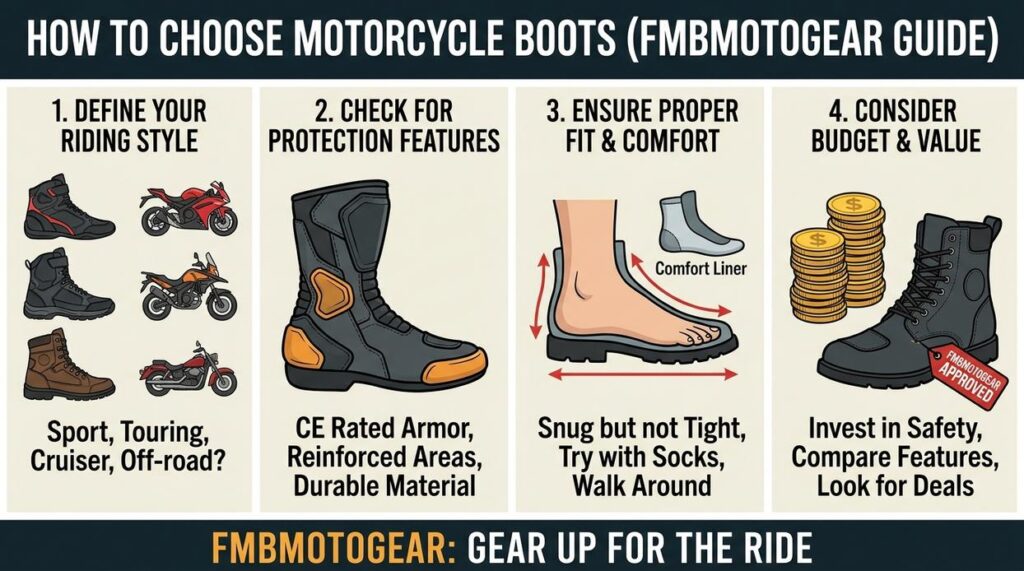
The EN 13634:2017 standard is what motorcycle boots get tested against in Europe. When you see those numbers, it means the boots passed tests for abrasion resistance, impact protection, and crush resistance.
But here’s the part nobody explains. There are different levels. A basic CE rating doesn’t guarantee ankle armor or reinforced zones. You need to look deeper.
Ankle Armor is Non-Negotiable
Your malleolus bones (those knobby parts on each side of your ankle) are incredibly fragile. I’m talking about bones that can shatter from a low-speed tip over.
Good boots have both internal and external ankle protection. Pucks or sliders on the outside. Armor cups on the inside. When you’re learning how to choose motorcycle boots fmbmotogear, this should be your first checkpoint.
Skip this and you’re gambling with your ability to walk normally.
Reinforced Zones Matter
Toe boxes get crushed under bikes. Heel counters prevent your foot from rolling in a slide. Shin plates stop direct impacts from breaking your tibia.
These aren’t optional upgrades. They’re the difference between walking away and spending months in recovery.
Sole Construction
An oil-resistant sole keeps you from slipping at gas stations (trust me, it happens). Anti-slip tread gives you confidence at stoplights. A steel or composite shank prevents your foot from folding around the footpeg during impact.
That last one? Most riders don’t think about it until it’s too late.
Material Matters: Leather vs. Advanced Textiles
You’ve probably heard riders argue about this for hours.
Leather purists swear nothing else comes close. Synthetic fans say old-school riders are stuck in the past.
Here’s what I think after testing both.
The Gold Standard: Full-Grain Leather
Full-grain leather still holds up better than almost anything else when you hit pavement. The abrasion resistance is real. I’ve seen boots that saved feet in crashes where cheaper materials would’ve shredded.
But there’s more to it than just crash protection.
Leather molds to your foot over time. Those stiff boots that hurt like hell on day one? Give them a few weeks and they fit like they were custom-made for you. That’s something synthetics just can’t replicate.
The downside? They’re heavy. And that break-in period can be brutal.
The Rise of Microfiber & Synthetics
Modern synthetic materials changed the game though.
Microfiber boots weigh less. Sometimes a full pound less per boot. That matters when you’re on your feet all day or working the shifter constantly.
They also break in faster. You can wear them right out of the box without wanting to cut your feet off. And they usually cost less than premium leather options.
The protection is solid too. Quality synthetics will keep you safe in most situations. They’re not as abrasion-resistant as full-grain leather, but they’re close enough for many riders.
Weatherproofing & Breathability
Then there’s the weather question.
Gore-Tex and similar waterproof membranes keep your feet dry in rain. I mean bone dry. But here’s the catch (and it’s a big one). Those same membranes trap heat like crazy in summer.
You have to pick your priority. Riding in Seattle? Waterproof makes sense. San Antonio in July? You want all the airflow you can get.
Some boots try to split the difference with partial waterproofing or removable liners. When you’re figuring out how to choose motorcycle boots fmbmotogear, think about where you actually ride most of the time.
A fully waterproof boot in hot climates will make you miserable. A mesh boot in constant rain will too.
Match the material to your conditions. Not to what looks cool or what some forum told you to buy.
The Perfect Fit: How a Motorcycle Boot Should Feel
You know that feeling when you try on a boot and something just feels off?
Maybe it’s too tight across the top of your foot. Or your heel slides around when you walk. Or your toes are already cramped before you even zip it up.
Here’s what most gear guides won’t tell you. That discomfort you’re feeling? It’s not always going to break in.
I’ve talked to riders who suffered through months of blisters because someone told them their boots just needed time. Sometimes that’s true. Sometimes you just bought the wrong size.
Let me walk you through what a proper fit actually feels like.
Your heel and ankle should feel locked in. When you lift your foot, the boot should come with it. If your heel lifts more than a quarter inch inside the boot, go down a half size.
But here’s the part people get wrong. Snug doesn’t mean strangling.
Your toes need wiggle room. Not enough to tap dance, but enough that you’re not curling them to fit. I always tell people to stand up and flex their foot forward like they’re working the shifter. If your toes jam into the front, you’re going to hate life on a long ride.
The sock test matters more than you think. Don’t try on boots wearing thin dress socks if you ride in thick merino wool. Bring your actual riding socks to the store (or keep them handy if you’re ordering online and doing home try-ons).
Now about break-in periods.
Quality leather boots will feel stiff at first. That’s normal. Give them 20 to 30 hours of wear and the leather will start conforming to your foot. But if they’re painful right out of the box, they’re probably not going to get better. There’s a difference between firm and hurting.
Textile boots? Most feel pretty much the same on day one as they will on day 100. What you feel in the store is what you get.
Closure systems change everything about fit adjustment.
Laces give you the most control. You can tighten the toe box differently than the ankle. But they’re slow to get on and off.
Zippers are fast. I can get in and out of my zippered boots in seconds. But you’re limited to whatever adjustment the strap or lace system provides.
Buckles sit somewhere in between. Quick to adjust and they stay put, but you’ve got fewer points of fine-tuning than laces.
When you’re figuring out how to choose motorcycle boots fmbmotogear, remember this. The best closure system is the one you’ll actually use correctly every single ride.
Matching the Boot to Your Riding Style
I’ll be honest with you.
Picking the right motorcycle boot isn’t as simple as matching it to what you ride. I wish it were.
You’ll see guides that say “sport bike equals race boots” or “cruiser means short boots.” But that’s not how it actually works.
Your riding style matters more than your bike.
Race & Track Boots give you the highest protection level. They’re rigid and built for performance. If you’re pushing hard through corners or spending time at the track, this is where you want to be.
Touring & Commuting Boots balance protection with all-day comfort. They handle weather better too. Most riders I know end up here because they’re logging serious highway miles.
Adventure Boots sit somewhere between motocross and touring. They work on-road and off-road, which sounds perfect until you realize they’re often a compromise on both (though some riders swear by them).
Short Boots & Riding Shoes work for urban riding. You get core protection in something that looks almost normal. Great for quick trips around town.
Here’s what I’m not sure about though.
The line between these categories keeps blurring. Some touring boots now offer track-level protection. Some short boots claim ADV capability. It gets confusing fast.
What I do know is this. Think about how you actually ride, not how you want to ride. If you’re honest about that, how to choose motorcycle boots fmbmotogear becomes a lot clearer.
Your feet will thank you either way.
Investing in Your Safety
You now know how to assess any motorcycle boot that crosses your path.
Look at the protective features. Check the materials. Match the boot to your riding style.
The risk of choosing the wrong boot is real. A cheap pair might save you money today but cost you later when it matters most.
This guide gives you what you need to make a smart choice. You can pick boots that actually protect you and fit how you ride.
Here’s what to do next: Check out our collection of how to choose motorcycle boots fmbmotogear that meet certified safety standards. Find a pair that matches your needs and get back on the road with confidence.
Your safety isn’t something to gamble with. The right boots make all the difference when you need them.
 Tracy W. is the founder of FMB Moto Gear, a platform dedicated to delivering informative coverage on motorcycles, rider equipment, and the evolving moto lifestyle. Passionate about road culture and vehicle innovation, Tracy created the platform to help riders stay informed about modern gear, safety practices, maintenance techniques, and industry trends.